
What's The Big News?
Big news coming out of the JSW MG Motor India camp. SAIC Motor, the Chinese automaker, is reportedly selling another 10% stake to JSW Group. This bumps JSW's ownership up from 35% to a controlling 45%, making them the largest shareholder. Could this be a game-changer for MG in India?
What does this mean for you, the Indian car buyer? Well, a larger stake for JSW could mean more India-centric decisions. Think more localization, potentially better pricing, and maybe even models tailored specifically for our market. Let's dive into what this power shift could bring.
JSW Takes The Wheel: What It Means For MG's Future
For a while now, SAIC's control over MG Motor India has raised eyebrows. There were concerns about the level of investment and commitment to the Indian market. This move signals a potential shift in strategy. With JSW Group taking the lead, we might see a greater focus on local manufacturing and sourcing. It's a chance for MG to become more 'Indian' – something that resonates deeply with buyers here. Remember Tata's rise? A similar homegrown push could work wonders for MG too.
The Indian car market is unique, and understanding its nuances is crucial. JSW's increased involvement could lead to quicker decision-making and faster adaptation to changing consumer preferences. Expect to see a renewed emphasis on value-for-money offerings, efficient after-sales service, and potentially, a stronger push into the EV space. After all, JSW has big ambitions in the renewable energy sector, so electric cars are a natural fit.
More Investment, More Localisation?
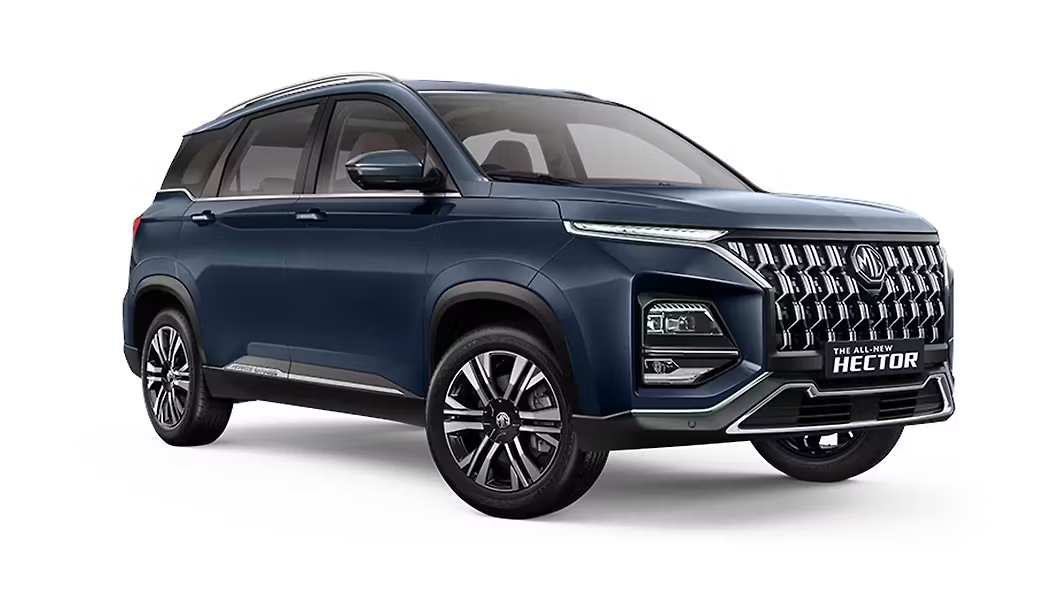
One of the biggest benefits of JSW's increased stake is the potential for increased investment in local manufacturing. Currently, MG relies heavily on imported components, which impacts pricing. Greater localisation can bring costs down, making MG cars more competitive. Think of it like this: a locally-made MG Hector could potentially undercut rivals like the Tata Harrier and Mahindra XUV700 on price. Now that's something to get excited about.
Furthermore, a stronger local presence allows MG to develop models specifically tailored to Indian needs. We could see more affordable EVs, feature-rich hatchbacks, or even a rugged SUV designed for our challenging road conditions. The possibilities are endless. It's about time someone took the fight to Maruti Suzuki and Hyundai in the volume segments.
Specs At A Glance
Model | Engine | Power | Torque | Expected Price |
|---|---|---|---|---|
MG Hector | 1.5L Turbo Petrol / 2.0L Diesel | 143 PS / 170 PS | 250 Nm / 350 Nm | ₹13.99 Lakh onwards |
1.5L Petrol / 1.3L Turbo Petrol | 110 PS / 140 PS | 144 Nm / 220 Nm | ₹10.82 Lakh onwards | |
Electric Motor | 176 PS | 280 Nm | ₹23.38 Lakh onwards |
How Does It Stack Up Against The Competition?
MG Motor India faces stiff competition from established players like Maruti Suzuki, Hyundai, Tata Motors, and Mahindra. The Hector competes with the Tata Harrier and Mahindra XUV700, while the Astor rivals the Hyundai Creta and Kia Seltos. The ZS EV goes up against the Tata Nexon EV and Mahindra XUV400.
Where MG needs to improve is after-sales service and brand perception. Tata and Mahindra have a stronger network and a more 'Indian' image, which resonates with many buyers. Hyundai and Maruti offer unmatched reliability and peace of mind. MG needs to address these areas to truly challenge the established players.
The Good And The Not-So-Good
What We Like
- Bold designs and feature-rich interiors
- Competitive pricing (especially if localisation increases)
- Growing EV portfolio with the ZS EV
What Could Be Better
- After-sales service network needs improvement
- Brand perception needs a more 'Indian' touch
- Parts availability can be an issue
Price & When You Can Buy It
The deal between SAIC and JSW is expected to close soon. We don't anticipate immediate price changes, but increased localisation in the future could lead to more competitive pricing. Keep an eye out for new model launches and updates in the coming months.
Our Verdict
JSW Group taking a bigger slice of MG Motor India is a positive sign. It opens the door for more India-centric strategies, increased localisation, and potentially, better value for money for the Indian car buyer. However, MG still has work to do to improve its brand image and after-sales service. It's a wait-and-watch situation, but the potential is definitely there. Honestly, I think this could be the push MG needs to truly make its mark in India. It's about time they shook things up a bit.