
What's The Big News?
Remember Honda's insane V3R prototype from EICMA? That bike with its compact V3 engine and an electrically driven supercharger? Well, turns out it wasn't just a show pony, folks. Fresh patent filings coming out of Japan suggest this revolutionary e-compressor tech is destined for more than just one niche model.
This is huge. We're talking about a potential game-changer for how performance motorcycles are built and ridden. Honda isn't just dabbling; they're clearly invested in bringing this sophisticated forced-induction system to a wider range of future bikes. For us enthusiasts, this means more power, better throttle response, and hopefully, cleaner emissions, all in one neat package.
Honda's Electric Boost: How It Works & Why It Matters
So, what exactly is this 'e-compressor' magic all about? Essentially, it's an electrically driven supercharger. Think of it like a mini turbocharger, but instead of using exhaust gases to spin it up, it uses an electric motor. This is a massive advantage because it virtually eliminates 'turbo lag' – that annoying delay you sometimes get with traditional turbos before the power kicks in. With an e-compressor, you get instant boost, right from low RPMs. Imagine hitting the throttle on your favourite twisty road and getting that surge of power without waiting. That's the promise here.
This isn't just about raw power, though. The beauty of an electric system is its precise control. The compressor can be engaged and disengaged exactly when needed, optimizing both performance and fuel efficiency. It means you could have a bike that's tractable and easy to ride in city traffic, but unleash serious horses on the highway. We feel this kind of adaptable power delivery is exactly what modern riders are looking for, especially with stricter emission norms becoming a reality. It’s a clever way to squeeze more out of smaller displacement engines without making them overly complex or fuel-guzzling. About time, manufacturers looked beyond just bigger cubes!
What Bikes Could Get This Tech, And The Market Impact
Which Honda bikes could actually get this tech? While the V3R was a V3, the patents don't restrict it to that specific engine layout. We could see this e-compressor finding its way into a variety of Honda's performance-oriented machines – perhaps a new CBR, a more potent Hornet, or even adventure tourers that need that extra grunt for mountain passes. Imagine a mid-capacity sportbike suddenly punching above its weight, all thanks to an electric boost. It’s a bit like getting a performance upgrade without significantly increasing engine size or weight, which is always a win for handling.
Look, this isn't Honda's first dance with forced induction; remember the RC213V-S, which had a version of supercharging (though mechanically driven). But integrating an electric compressor marks a significant step forward. Other manufacturers, like Kawasaki with their H2 series, have shown what supercharging can do for motorcycles. Honda's approach, leveraging an electric motor, promises even finer control and potentially better integration into everyday riding. This tech could redefine what we expect from a 600cc or even 800cc motorcycle – giving it the punch of a litre-class machine without the intimidating weight or price tag (yes, really).
Specs At A Glance
Feature | Details |
|---|---|
Engine Type | Compact V3 (Prototype V3R) |
Forced Induction | Electrically Driven Supercharger / E-Compressor |
Power Output | TBA (Expected significant boost) |
Torque Output | TBA |
Expected Applications | Future Honda performance motorcycles |
How Does It Stack Up Against The Competition?
So, how does this electric supercharger concept stack up against what's already out there or what rivals are doing? Currently, Kawasaki's H2 series is the most prominent example of forced induction in mainstream motorcycles, using a mechanically driven supercharger. Those bikes are absolute rockets, no doubt. But Honda's electric approach offers a few distinct advantages. For one, the electric motor allows for much more precise and instantaneous control over boost pressure, leading to virtually zero lag. This means smoother power delivery and potentially better fuel efficiency when the boost isn't needed.
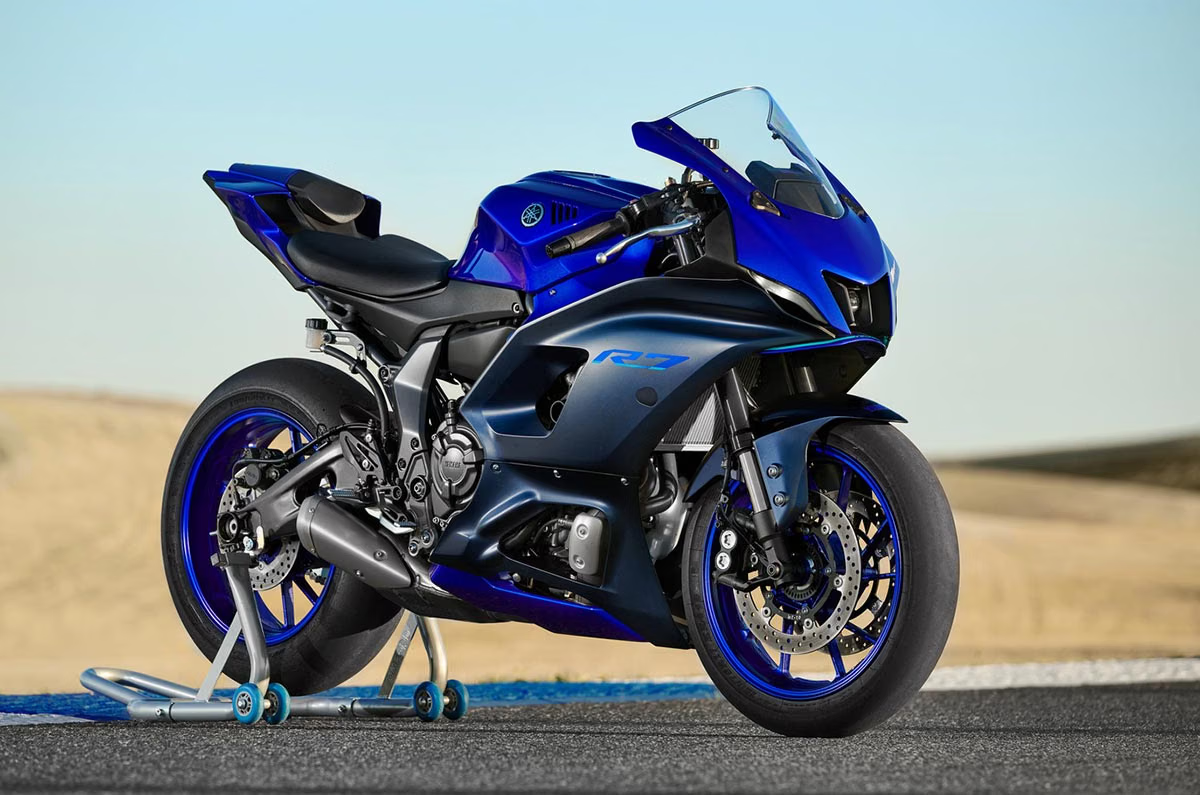
Then there are high-performance naturally aspirated bikes from manufacturers like Yamaha (R1, R7) or Suzuki (GSX-R series), which rely on high revs and larger displacements for their power. While incredibly potent, they don't offer the low-end surge that forced induction can provide. Honestly, Honda's e-compressor tech could bridge that gap, giving riders the best of both worlds: strong low-to-mid range grunt without sacrificing the high-revving excitement, and all wrapped in a more compact package than a massive engine. It’s an interesting play, potentially offering a more refined and adaptable performance characteristic compared to the raw, always-on power delivery of some existing supercharged bikes.
The Good And The Not-So-Good
What We Like
- Instantaneous Power Delivery: Electric drive means no turbo lag, just immediate boost.
- Enhanced Efficiency: Precise control allows for better fuel economy when boost isn't required.
- Versatile Application: Could be adapted to various engine sizes and bike types.
- Potential for Smaller, Lighter Engines: Achieve higher power outputs without increasing engine displacement significantly.
- Forward-Thinking Innovation: Honda pushing boundaries in performance and emission control.
What Could Be Better
- Complexity & Cost: Adding an electric supercharger system will likely increase the bike's complexity and potentially, its price.
- Weight Addition: The e-compressor and associated electrical components will add some weight, however small.
- Reliability Concerns (Initial Stages): New technology always has initial reliability questions.
- Availability: It's still in the patent phase; mass production and specific model applications are TBD.
- Maintenance: How will this impact long-term service and maintenance costs for Indian owners?
Price & When You Can Buy It
Alright, the million-dollar question: when can you actually get your hands on a bike with this tech, and how much will it pinch your wallet? Here's the thing — this e-compressor system is still in the patent and prototype phase. While the V3R was showcased, and patents filed, there's no official word on which production models will feature it, or when they'll launch.
So, specific pricing is completely unknown right now. We expect bikes featuring this advanced technology to sit at the premium end of their respective segments, given the R&D and sophisticated components involved. Don't expect it on a commuter bike anytime soon, but it could trickle down to more accessible performance models over time. For now, it's a 'wait and watch' situation, but definitely one to keep an eye on for Honda loyalists!
Our Verdict
So, where do we land on Honda's e-compressor tech? Honestly, this is a seriously exciting development for the world of motorcycles. It shows Honda isn't content to rest on its laurels; they're actively innovating to push performance boundaries while also keeping an eye on future regulations. The promise of instant, controllable power delivery across a wide range of RPMs is incredibly appealing for any rider. Imagine the possibilities for everything from track days to touring. It’s a sophisticated solution to a common problem, and if Honda can bring it to market reliably and at a somewhat reasonable premium, it could absolutely redefine what we expect from a performance motorcycle. This isn't just about more horsepower; it's about smarter, more usable horsepower. We're definitely keen to see this move from patent drawings to actual production bikes on Indian roads!